The piano is one of the most rewarding instruments you can learn. It teaches you music theory visually, builds coordination in both hands, and gives you access to an enormous range of music.
If you are just starting out, this guide will take you from zero to playing your first simple songs, with practical steps you can follow right now.
Why Piano Is an Ideal First Instrument
The piano keyboard lays out notes in a logical, visual sequence. You can see exactly how scales, chords, and intervals are constructed. This makes it an excellent tool for understanding music theory for beginners in a tangible way.
Unlike wind or string instruments, the piano produces a clear tone the moment you press a key. There is no embouchure to develop, no bow technique to master. You can focus entirely on learning notes and rhythm from your very first session.
Setting Up Your Practice Space
Before your first practice, set up your keyboard or piano at a comfortable height. Your elbows should sit at roughly the same level as the keys when your arms hang naturally. Sit up straight on a bench or stool with both feet flat on the floor.
Good posture from the start prevents tension and injury down the line. Many beginners develop bad habits early that slow their progress. Getting this right at the beginning saves you months of correction later.
Getting to Know the Keyboard
A standard piano has 88 keys arranged in a repeating pattern of white and black keys. The black keys appear in groups of two and three. This grouping is your navigation system.
Middle C is the anchor point for most beginners. It sits just to the left of the group of two black keys in the center of the keyboard. From Middle C, the white keys move alphabetically up to G, then repeat from A. Learning this layout is your first task.
Spend a few minutes just naming the keys as you press them. No rhythm, no music yet. Just building a mental map of the keyboard.
How to Position Your Hands Correctly
Curved fingers are essential. Imagine holding a small ball in each hand. Your fingers should curve naturally over the keys, with your fingertips, not the flat pads, making contact with the keys.
Keep your wrists level and relaxed. Avoid collapsing the wrist downward or lifting it too high. Tension in the wrist travels up the arm and causes fatigue quickly.
Each finger has a number. Thumb is 1, index is 2, middle is 3, ring is 4, pinky is 5. Sheet music and exercise books use these numbers to tell you which finger plays which note.
Learning Your First Notes and Scales
Start with the C major scale. Beginning on Middle C, play each white key up to the next C. The pattern is C, D, E, F, G, A, B, C. Practice this with your right hand first, then your left, then both together.
Scales may feel tedious, but they build the finger independence and muscle memory that every piece of piano music demands. Practice slowly. Speed will come on its own once accuracy is in place.
How to Read Sheet Music for Piano
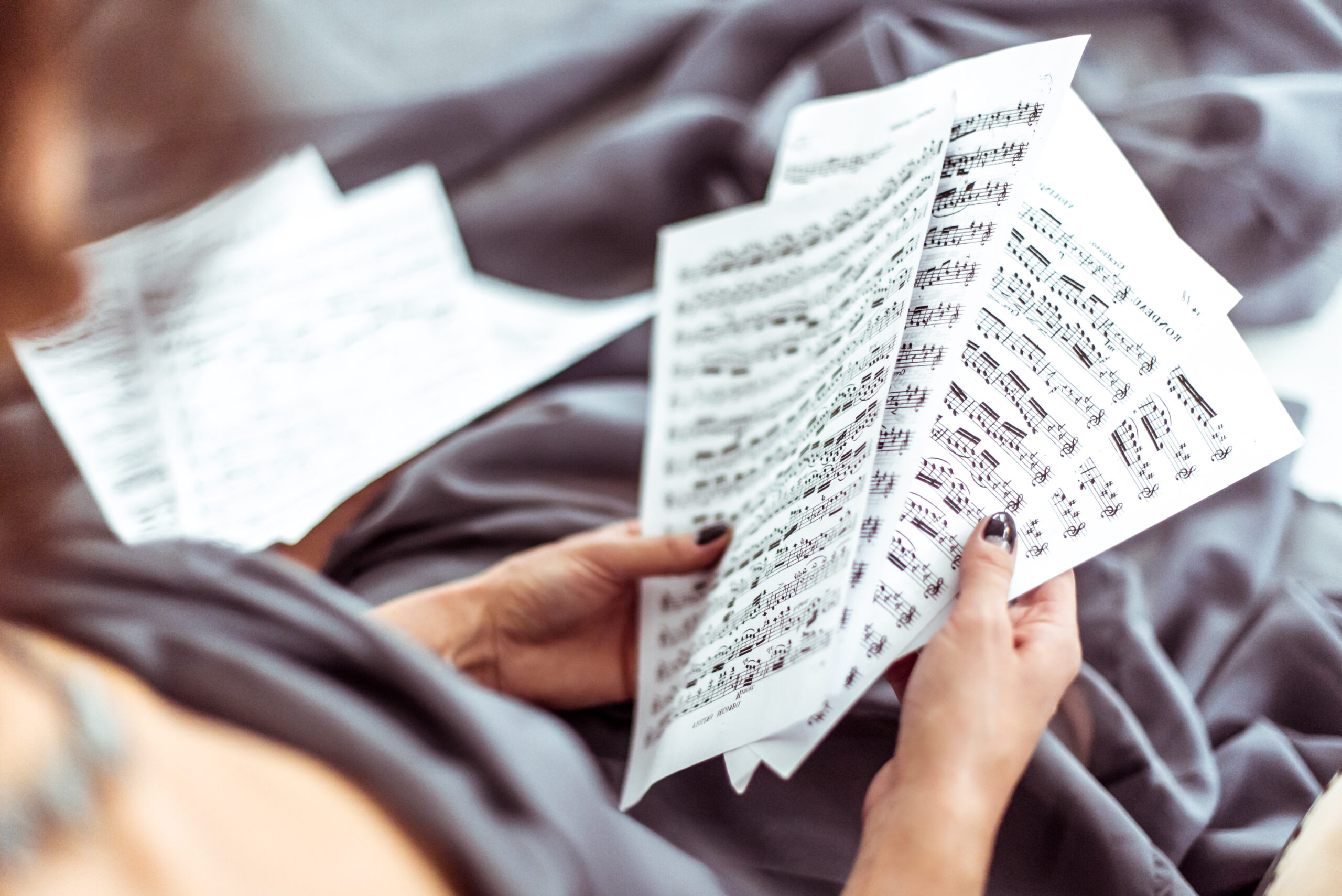
Reading sheet music is a core skill for any serious beginner. Piano music uses two staves, one for the right hand in treble clef and one for the left hand in bass clef. At first, focus on learning one hand at a time.
How to read music does not need to feel overwhelming. Start by identifying the notes for just a few positions on the staff, then gradually expand. Use the phrase “Every Good Boy Does Fine” for the treble clef lines and “Good Boys Do Fine Always” for the bass clef lines.
Practice reading simple melodies before adding both hands together. Music lessons for beginners almost always follow this approach, and it works.
Your First Songs to Learn
Choose pieces that use only a handful of notes. Classic beginner pieces like “Ode to Joy,” “Mary Had a Little Lamb,” and simple arrangements of folk songs are ideal. They are short enough to memorize quickly and satisfying to perform.
Once you can play a simple melody cleanly with one hand, add the left hand. Start with a simple bass note or chord on each beat rather than trying to play a full accompaniment immediately.
The Benefits of Learning an Instrument Like Piano
The benefits of learning an instrument are well documented. Piano practice builds working memory, sharpens concentration, and develops fine motor coordination. Children who learn piano often perform better academically. Adults who take it up report reduced stress and a meaningful sense of achievement.
Beyond the cognitive benefits, piano gives you a skill that lasts a lifetime. Unlike many hobbies, there is always something new to learn and no ceiling on how far you can progress.
How to Stay Consistent as a Beginner
Practice every day, even for just fifteen minutes. Short daily sessions beat long infrequent ones in almost every study on skill acquisition. Set a specific time for practice and treat it like any other commitment.
Record yourself playing. It is one of the most effective tools available to a self-directed learner. Hearing your own playing back reveals mistakes you miss in the moment and shows you your real progress over time.
Start Playing Today
You do not need a full 88-key piano to begin. A basic 61-key keyboard with weighted or semi-weighted keys is enough to learn all the fundamentals. Focus on good technique, consistent practice, and learning music you enjoy.
The piano rewards patience. Every session builds on the last, and the progress you make in the first few months will motivate you to keep going for years.